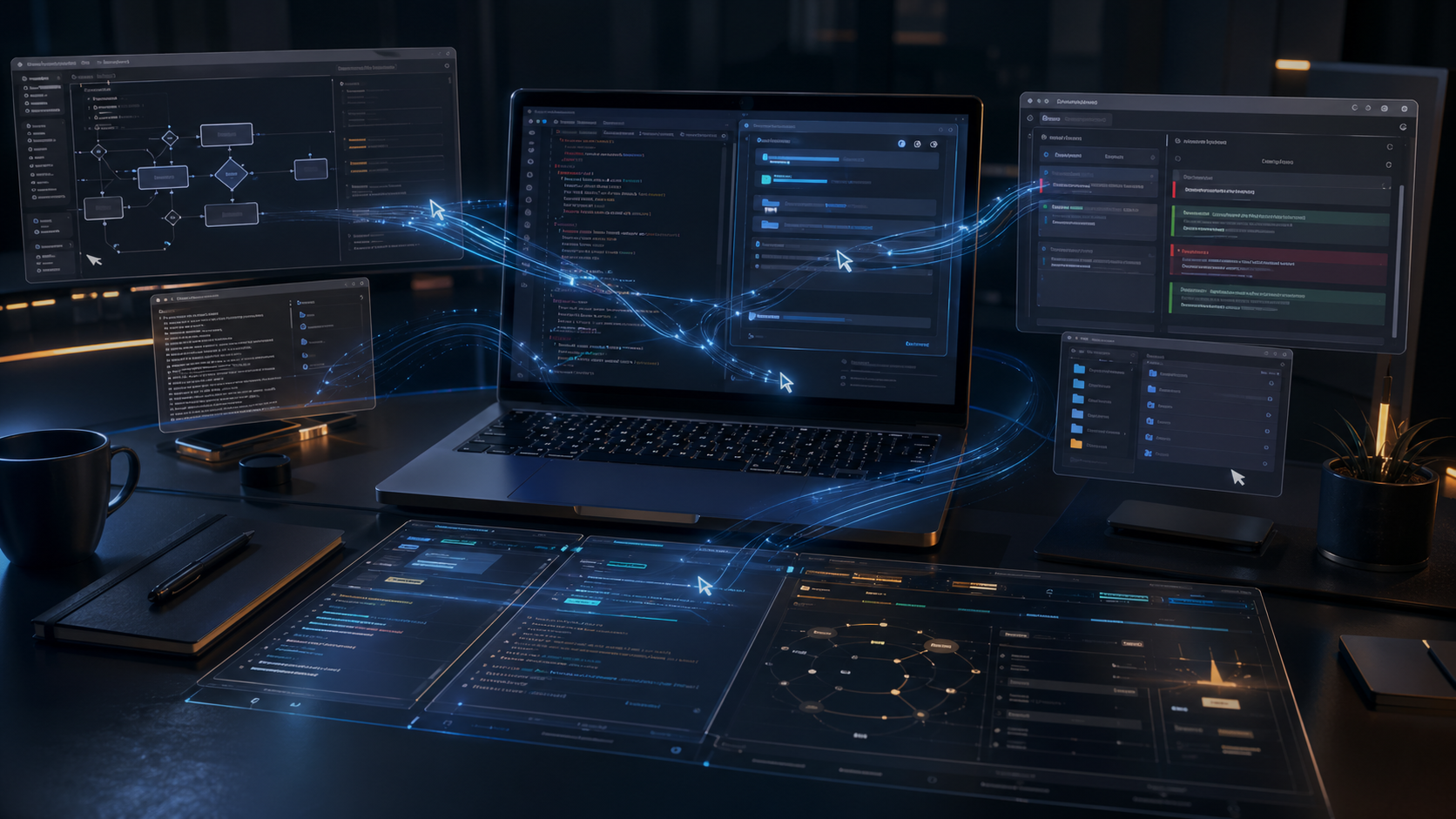
OpenAI's newest Codex release is being framed as a product update, but the more honest description is a workflow land grab. In the official April 16, 2026 announcement, OpenAI said Codex can now operate a computer alongside the user, click and type with its own cursor, remember preferences, schedule future work, and coordinate with a growing set of plugins and tools.
That is not just "better coding." It is OpenAI making a direct bet that the next software interface is not a chatbot tab or an IDE sidebar. It is a delegated coworker that can move across apps, files, terminals, browsers, and recurring tasks while you keep working on something else.
Codex Leaves the Terminal
For the past year, AI coding products have mostly fought inside familiar surfaces: IDEs, repos, pull requests, command lines. OpenAI's update widens the frame. Per OpenAI, Codex can now "operate your computer alongside you" with background computer use, and multiple agents can work in parallel without taking over the user's active workflow.
That matters because real software work rarely stays inside the editor. Frontend iteration means checking browsers. Debugging means following logs and dashboards. Shipping means looking at CI, docs, review comments, and project trackers. The moment an agent can cross those boundaries reliably, it stops feeling like autocomplete with ambition and starts looking like labor.
Why Parallel Desktop Work Matters
The most important line in OpenAI's launch post is not about image generation or memory. It is the claim that multiple agents can work on your machine in parallel "without interfering with your own work". That is the product promise teams have been waiting for: not full automation, but useful background execution.
In practice, that could mean asking one agent to review a pull request, another to test a local frontend flow, and a third to prep a bugfix branch while a human continues making higher-level decisions. The real appeal is not that the agent replaces the developer. It is that it absorbs the context-switching tax that makes modern engineering feel fragmented.
| Capability | What OpenAI Added | Why It Matters |
|---|---|---|
| Background computer use | Codex can click and type across desktop apps with its own cursor | Moves agent work beyond code generation into real workflow execution |
| Parallel agents | Multiple Codex agents can work while the user stays active | Makes delegation feel additive instead of disruptive |
| In-app browser | Users can annotate pages directly to guide the agent | Speeds up frontend iteration and app testing |
| Automations + memory | Codex can resume work later and remember useful context | Pushes agents from session-based helpers toward ongoing teammates |
A Direct Shot at Claude Code
OpenAI is not releasing these features into a vacuum. TechCrunch described the update as a move aimed squarely at Anthropic, whose Claude Code products have become unusually popular with developers and enterprise teams this spring.
That context matters for Sonarlink's editorial lens. This is not merely a feature race over who can write cleaner code. It is a platform race over who becomes the default operating layer for technical work. Anthropic has momentum with developers. OpenAI is responding by making Codex broader, more ambient, and more deeply wired into the rest of the workday.
What Else OpenAI Added
The release reaches further than desktop control. OpenAI says Codex now has an in-app browser, richer file previews, support for multiple terminal tabs, support for GitHub review comments, remote devbox access over SSH in alpha, a summary pane, memory, and automations that can wake up later to continue work. OpenAI also said it is shipping more than 90 additional plugins to extend context and actions across other tools.
Taken separately, each feature sounds incremental. Taken together, they outline a different product category: one place to supervise a team of software agents that can cross from code to browser to docs to task systems and back again.
The Real Story Is Delegation
The safest way to read this launch is not "OpenAI made its coding app better." It is "OpenAI thinks software work is about to become managerially orchestrated." Humans set priorities, judge taste, resolve ambiguity, and decide when enough is enough. Agents do the scavenging, editing, verifying, and repetitive traversal of tool surfaces.
That is why this feels like Sonarlink's best next article. It is current, it fits the site's audience, and it fills a category gap with a story that is bigger than one launch. If OpenAI is right, the next battle in AI is not model quality alone. It is whether developers are willing to hand more of the workday to systems that can move through the rest of the machine for them.

AI-Generated Content
This article was researched, written, and verified by Sonarlink's AI using primary product announcements and supporting reporting.
More from Sonarlink
AI Agents in 2026: How Agentic Workflows Are Reshaping Enterprise Work
Enterprise AI agents moved from pilot to production. Here are the tools driving the shift.
OpenAI's ChatGPT Images 2.0 Can Think Before It Draws
OpenAI's first image model with reasoning added sharper text, flexible aspect ratios, and up to 2K output.
SpaceX Can Buy Cursor for $60B — or Pay $10B for the Partnership
One of the week's clearest signals that AI software assets are becoming strategic infrastructure.