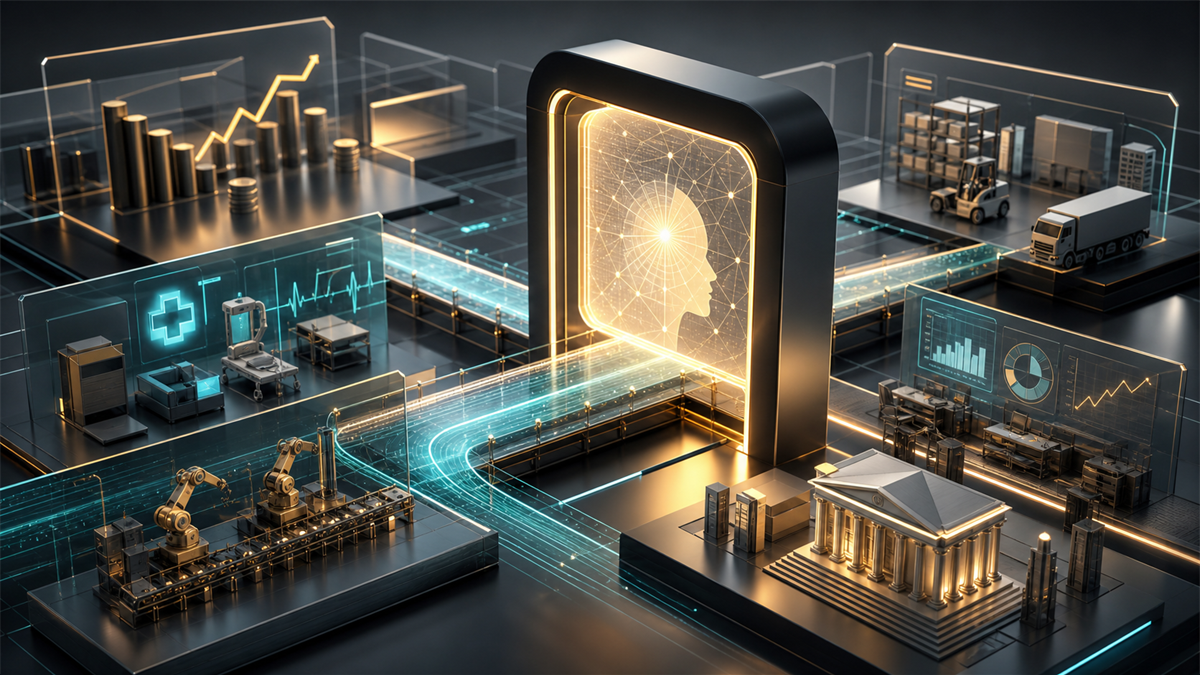
Anthropic is building a new route into corporate America. On May 4, the Claude maker announced a new AI-native enterprise services company with Blackstone, Hellman & Friedman, and Goldman Sachs, designed to help mid-sized companies put Claude into core business operations.
The official announcement frames the firm as a standalone entity with Anthropic engineering and partnership resources embedded in the team. The Wall Street Journal first reported that the venture is valued around $1.5 billion, and TechCrunch reported that the structure includes roughly $300 million commitments from Anthropic, Blackstone, and Hellman & Friedman. That makes this more than a sales partnership. It is a distribution machine.
The New Delivery Layer
Anthropic's product problem is no longer just whether Claude is powerful enough. The harder question is how many real companies can rebuild work around it. That requires people who understand operations, compliance, messy software stacks, and the difference between a demo and a system that survives a quarter-end close.
The new firm is built for that gap. Anthropic said its applied AI engineers will work alongside the company's engineering team to identify where Claude can have the most impact, build custom systems, and support customers over time. The initial target is not only the largest global enterprises. It is mid-sized companies across sectors, including healthcare, manufacturing, financial services, retail, real estate, and infrastructure.
Why Wall Street Matters
The investor list is the tell. Alongside the founding partners, the company is backed by General Atlantic, Leonard Green, Apollo Global Management, GIC, and Sequoia Capital. These are not passive brand names. They collectively touch hundreds of portfolio companies that already face margin pressure, automation pressure, and board-level demands to show an AI plan.
That gives Anthropic something more valuable than another cloud marketplace listing: access to operating companies that private-capital owners can push toward implementation. The pitch is not simply, buy Claude. It is, let a specialized team redesign workflows around Claude, then keep adapting those systems as the model changes.
| Traditional AI Sale | New Services Firm | Why It Matters |
|---|---|---|
| Licenses and API access | Embedded engineering teams | Moves AI from experimentation into operating workflows |
| Customer finds use cases | Joint team maps work directly | Reduces the gap between model capability and business value |
| Generic enterprise rollout | Portfolio-company channel | Private capital can create repeatable deployment demand |
The Consulting Fight
This also puts Anthropic closer to the consulting industry. The company says its existing Claude Partner Network, including major systems integrators, remains central for large enterprise work. But the new firm adds a more AI-native delivery layer, with engineers tied more directly to Anthropic's research and product teams.
That distinction matters because frontier models change fast. Anthropic argues that systems built on Claude need to evolve as the underlying model improves. In older software transformations, implementation often meant a long requirements cycle and a stable product baseline. In AI, the model itself may materially change month to month. The service layer has to keep moving.
What Companies Actually Get
Anthropic gave a healthcare example: a multi-site physician practice where clinicians lose time to documentation, medical coding, prior authorizations, and compliance reviews. In that case, the engagement would start with engineers sitting with clinicians and IT staff, then building Claude-powered tools that fit existing workflows.
That example is useful because it avoids the usual generic productivity language. The point is not that every employee gets a chatbot. The point is that high-friction processes can be reworked around a model, with human domain experts shaping where automation helps and where it should stay constrained.
What To Watch Next
The broader signal is that frontier AI companies are turning deployment into a core business, not an afterthought. TechCrunch noted that OpenAI is preparing a similar enterprise services push, reportedly through a larger venture called The Development Company. Whether or not each structure lands exactly as reported, the competitive direction is clear.
Model labs are learning that enterprise adoption does not happen just because the model gets better. It happens when somebody does the difficult integration work, carries the change management burden, and proves that AI can alter business operations instead of sitting in a procurement dashboard.

AI-Generated Content
This article was researched and written from Anthropic's official announcement, Blackstone's partner release, Reuters coverage of the WSJ-reported venture structure, and TechCrunch reporting on the broader enterprise AI services race.
More from Sonarlink
Google's Anthropic Bet Is Really a Compute Deal
Alphabet may put up to $40 billion behind Claude while deepening the cloud-capacity relationship that keeps frontier AI scaling.
OpenAI Just Showed AWS What the AI Cloud Market Wants
OpenAI's AWS Bedrock expansion pushes the model market toward multi-cloud distribution and away from single-platform dependence.
Microsoft and OpenAI Just Rewrote the AI Cloud Map
The OpenAI-Microsoft reset loosens exclusivity and turns frontier AI distribution into a more explicitly multi-cloud market.