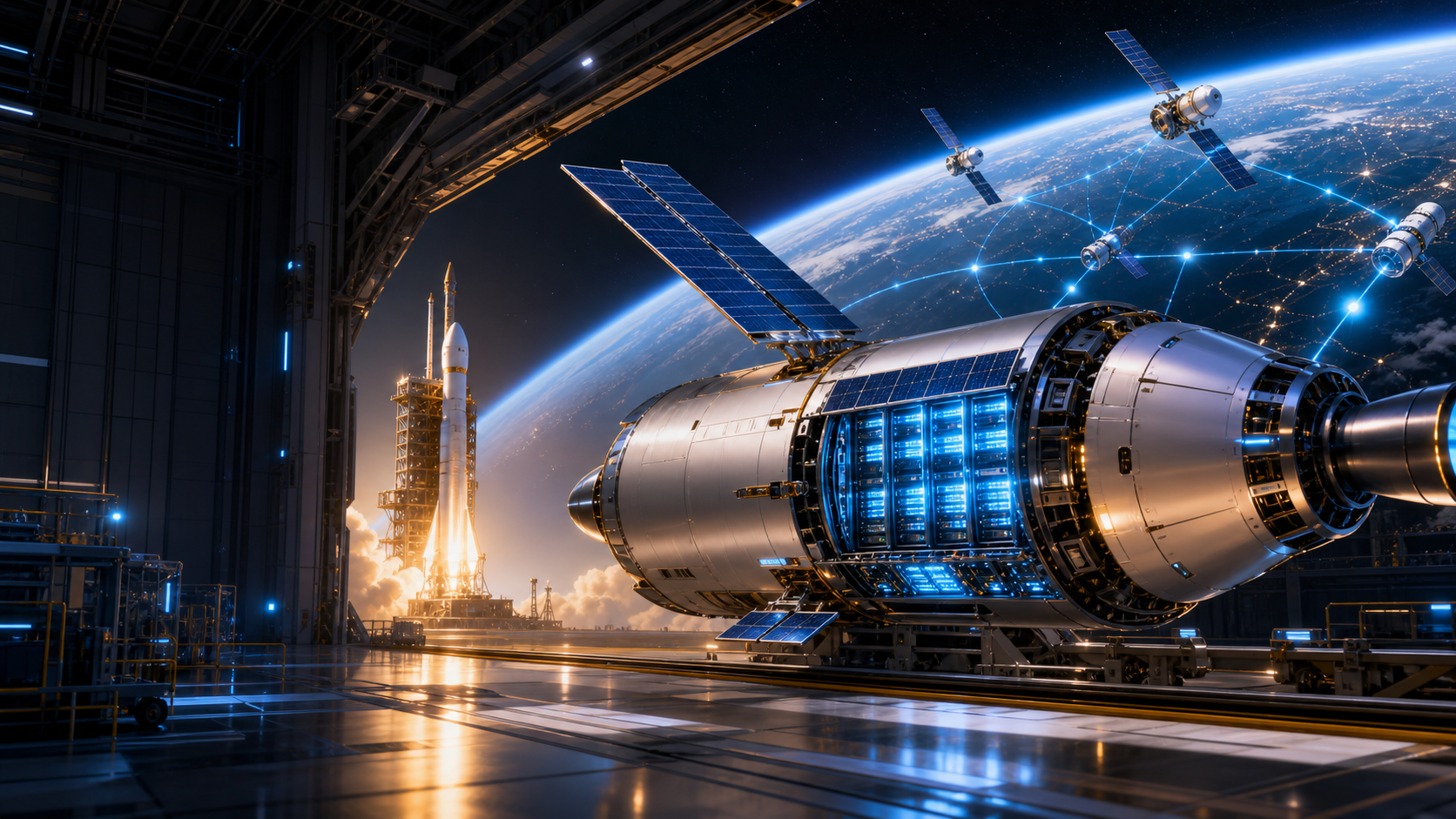
Cowboy Space Corporation wants to put AI data centers in orbit. The part that makes the story bigger is that it now wants to build the rockets too. Investing.com reported that the startup founded by Robinhood co-founder Baiju Bhatt raised $275 million in a Series B round at a $2 billion valuation.
The company, previously known as Aetherflux, says it is building orbital data centers powered by solar energy. Its latest twist is launch control. Bhatt told reporters that without its own rockets, the company would not control its own destiny. That is the useful signal: AI infrastructure pressure is moving beyond land, power, and chips. It is starting to turn rocket capacity into part of the compute stack.
The Rocket Bottleneck
Cowboy Space is not only pitching satellites with AI chips. It is targeting a 2028 first rocket launch, with an architecture where the rocket's upper stage becomes the satellite in orbit. That is a clever way to make launch hardware and orbital compute hardware collapse into one system, at least on paper.
The logic is simple. If orbital AI data centers become real, startups cannot wait in line forever for someone else's launch window. SpaceX dominates much of the reusable-launch conversation, and other launch providers are still scaling. Cowboy Space is betting that owning the ride matters as much as owning the data center.
Why Orbit Is Tempting
The pitch for orbital compute starts with energy. Aetherflux's own site says access to energy is a primary bottleneck for AI and argues that orbital data centers can place sunlight next to silicon instead of waiting years for land, utility connections, and terrestrial data center construction.
That is why space data centers keep reappearing in AI infrastructure conversations. Google has explored Project Suncatcher, Starcloud has raised funding for space-based compute, and SpaceX has been linked to ambitious orbital data center plans. The common premise is that AI workloads may eventually need power and siting options that Earth-bound infrastructure cannot provide quickly enough.
| Layer | What Cowboy Space Wants | AI Infrastructure Meaning |
|---|---|---|
| Compute | Orbital data center satellites | Moves part of the AI power problem above terrestrial grids |
| Energy | Solar-powered systems in orbit | Uses continuous sunlight as the core scaling argument |
| Launch | Company-owned rockets | Turns rocket capacity into a bottleneck Cowboy wants to control |
The Economics Problem
This is still a hard business to believe in at scale. TechCrunch's February analysis of orbital AI economics noted that a 1-gigawatt orbital data center could cost far more than a ground-based equivalent under baseline assumptions, largely because the hardware has to be built for space and then launched.
There are also technical constraints that do not vanish because the concept is exciting. AI training needs enormous high-speed interconnects between chips. Space systems face radiation, cooling, repair, debris, and latency questions. A startup can raise money on the vision, but the proof will be whether it can make the unit economics compete with data centers on Earth.
The New Space Stack
The reason Cowboy Space is worth watching is that it is trying to own more of the stack than a normal space startup. Data center satellite, energy architecture, and rocket are all part of the same plan. That resembles the logic of hyperscalers on Earth: control more of the infrastructure so bottlenecks do not stop the roadmap.
In that sense, Cowboy Space is part of the same industrialization trend showing up across AI. The frontier is less about clever demos and more about who can secure power, chips, land, launch, and deployment pathways. The moat is physical.
What To Watch
The first thing to watch is whether Cowboy Space can keep its nearer-term commitments. Investing.com reported that the company still plans to launch a satellite aboard a SpaceX rocket later this year, even as it targets its own rocket launch in 2028. That earlier satellite should give the market a clearer read on execution.
The second thing to watch is whether AI demand keeps making increasingly extreme infrastructure bets look rational. If terrestrial data centers become harder to power and permit, orbital compute will get more attention. If ground economics improve, space data centers may remain a capital-intensive edge case.

AI-Generated Content
This article was researched and written from Investing.com coverage, TechCrunch orbital AI economics reporting, Data Center Dynamics coverage, and Aetherflux source material.
More from Sonarlink
The AI Model Race Is Becoming a Compute Landlord Business
xAI's Colossus deal with Anthropic shows frontier AI power shifting from model demos to scarce compute capacity.
Amazon Turned OpenAI's Cloud Freedom Into an AWS Product
AWS is packaging OpenAI models, Codex, and managed agents inside Bedrock's enterprise control plane in limited preview.
Google's Anthropic Bet Is Really a Compute Deal
Alphabet may put up to $40 billion behind Claude while deepening the cloud-capacity relationship that keeps frontier AI scaling.